

By Daniel Kim
Student Caseworker
Founders launch startups for all kinds of reasons—financial upside, addressing a community need, or building something innovative to change the world. You move fast. You (maybe) break things.
But sooner or later, someone at the table asks:
“…do we need a lawyer?”
That’s where the uOttawa Startup Law Clinic comes in!
Clinic Open Now
Upper year law student caseworkers are now hosting free office hours in September and October, where founders and entrepreneurs can bring their questions and get legal information. Spots are still open!
What is the Startup Law Clinic?
We are a law student-run clinic supervised by Academic Director Doug Sarro. Professor Sarro founded the clinic in 2024 to support small and early-stage businesses, recognizing that start-ups face unique and complex legal issues, but at the same time, have barriers to accessing relevant (and expensive!) legal advice.
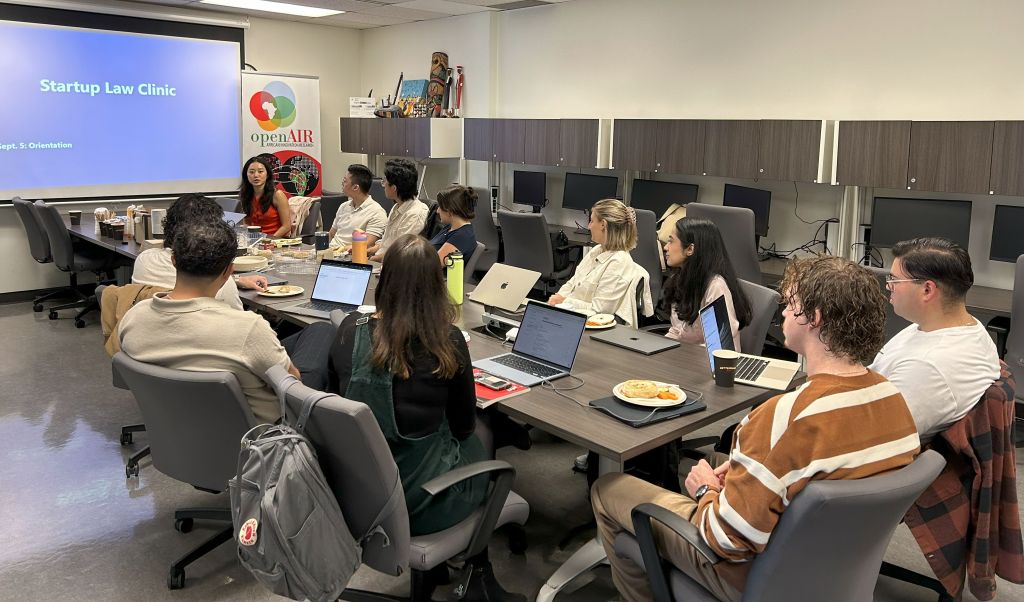
Joining him this year is the 2025 caseworker team. We come from diverse backgrounds and experiences, but a common thread is our strong interest in both helping entrepreneurs and practicing business law.
Personally, I joined this clinic because throughout law school, client-facing work was the highlight of all my work experiences. Both my first and second-year summer internships at the Canada Deposit Insurance Corporation (CDIC) and Kirkland & Ellis LLP gave me a chance to meet with clients and learn why they needed legal help. I then got to use my legal skills to help businesses solve issues that affected their day-to-day. For me, the clinic is a continuation of that aspect of legal practice.
Why startups face unique legal challenges
The student team has been holding weekly seminars covering the unique challenges that startups face and the many areas of law that a start-up touches on in its early days.
I’ve learned that unlike a small business, which may offer an existing product or service, startups have a distinctive lifecycle because they are built on novel and innovative ideas. Starting as a home-grown enterprise to seeking significant external funding can raise a myriad of legal questions!
Our seminars and training have canvassed how start-ups can face legal questions ranging from intellectual property and technology law to corporate and securities law to employment law. (Given the increasing specialization of lawyers’ expertise, that could be at least five lawyers!)
What the Clinic offers for founders
A free office hours consultation with the clinic means you’ll meet with two student caseworkers who will provide legal information to help you understand the legal issues or problem you’re dealing with.
Here’s a glimpse of the topics we’ve covered in our seminars in preparing to help entrepreneurs:
🚀 Protecting your ideas (IP and Technology Law): “How do I stop others from taking my idea?”
Intellectual property (IP) is the critical asset for startups. At office hours, we can talk about how people protect their IP in Canada—via trademarks, copyright, patents, and contract. We can also help you understand the difference between patents and trade secrets, and the limitations of intellectual property law in protecting your assets.
Additionally, we can discuss the importance of having terms of use and a privacy policy, typical provisions found in those policies, and obligations that Canada’s private-sector privacy legislation, PIPEDA, may place on startups.
💼 Structuring your startup (Corporate & Securities Law): “Should I incorporate?”, “How do I incorporate?”
We can talk about the differences between a sole proprietorship and a partnership and the key advantages of incorporation, which include limited liability for founders and investors (because the corporation is a separate legal person responsible for its own debts).
We can also provide information on how to incorporate, the requirements and steps involved, and the pros and cons of incorporating federally versus provincially.
We can also discuss questions such as splitting company ownership among a founding team and the various ways that startups typically raise capital, from common shares to convertible debt.
🤝 Building your team (Employment law): “How do I hire?”
Our student caseworkers can provide information on a variety of employment topics, including hiring employees, the difference between an employee and an independent contractor, and how equity compensation such as stock options works. We can also give you information on what typically is found in an employment contract and the importance of clauses regarding termination and intellectual property ownership.
How to Sign Up
Ready to tackle your legal questions? So are we! The team at the uOttawa Startup Law Clinic believes law doesn’t have to be a barrier to innovation, but rather a vehicle to help you prudently plan the future of your enterprise.
The clinic is now open, with appointments currently available in September and October. Book your free office hours appointment today!
 uOttawa Startup Law Clinic