

By Ella Lim
Student Caseworker
For the past two months, the student caseworkers at the uOttawa Startup Law Clinic spoke to over 15 founders and entrepreneurs in Ottawa and in the Greater Toronto Area.
During these calls, a common theme of question was related to employment—Is it legal to hire unpaid interns or student volunteers? What are the obligations as a business to hire employees? Is hiring a freelance worker the same as hiring an employee?
With this theme in mind, the Clinic is hosting a series of Townhalls to provide legal education to startup founders and entrepreneurial students. On November 28, we’ll host a presentation where students will provide the necessary tools in hiring employees as a startup.
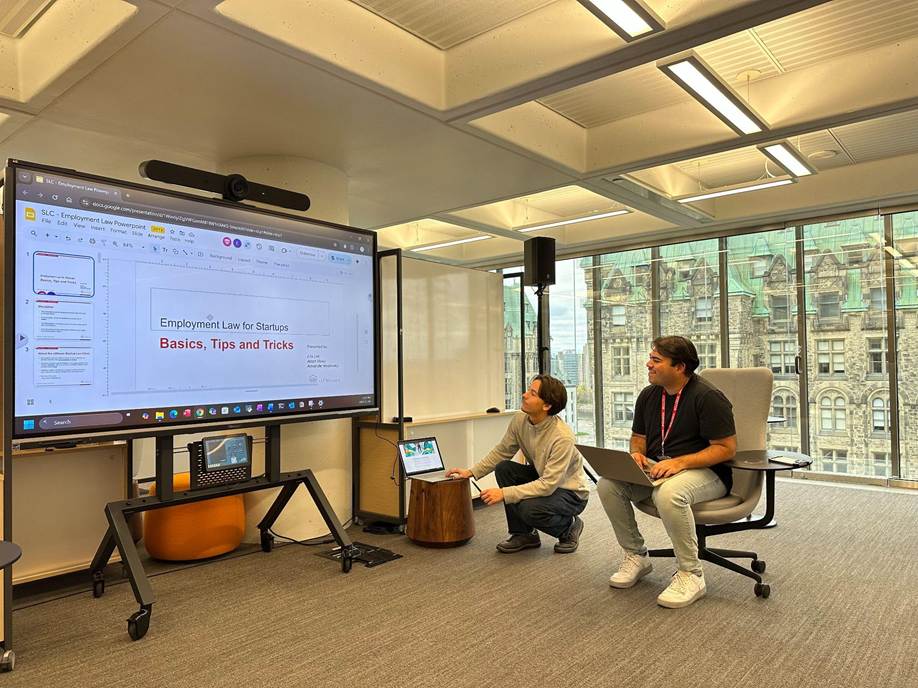
Preparing for the November 28th Townhall
As student caseworkers, preparing for this Townhall has been both exciting and eye-opening. Behind the scenes, we quickly realized that translating legal theory into practical information for startups requires us to switch our perspective—what would founders want to learn and how will the best learn it?. From researching employment standards to discussing how to best present case law on “how to classify a worker as an employee vs. an independent contractor” in plain language, every step challenged us to think like both lawyers and educators.
Here are a few takeaways:
Learning and Unlearning
Preparing for this presentation taught me something new. Not just about employment law, but about how to translate dense legal language into plain, actionable guidance for startups and their founders.
Entrepreneurs don’t need to know every detail of a case. Rather, they need to know why it’‘s important and how they can apply it to their startup.
One of the most critical steps after our legal research stage was presenting our research internally. This step allowed us to figure out what information was important and what to leave out of our presentation. From there, we began drafting our presentation, transforming our legal research to an engaging presentation.
This shift from “legalese” to “plain English” was one of the hardest and most rewarding parts of preparation.
Teamwork
Like in the startup world, the people you work with are key. The skills each team member brings and ability to collaborate can determine success.
Especially with limited opportunities in law school to work on a group presentation, preparing for the Townhall provided a perfect environment to collaborate with fellow law students. Where one team member brought strengths in knowledge of employment law and hiring practices, another brought an approach to presenting that aligned with startups and the business world. These perspectives, although different, allowed us to collaborate and learn from one another.
Prepare, Prepare, Prepare
On a more practical side, the Townhall required us to prepare by rehearsing, going through various drafts of our presentation, and anticipating audience questions. Our team met in person to rehearse our presentation, figuring out our individual presentation styles and how to best mesh them together. This rehearsal also taught me that preparation is less about control and more about adaptability—a skill every startup founder and law student alike has to master. Plans change, questions surprise you, and that’s where genuine connection and learning happen.
Preparing for this Townhall reminded me that law isn’t just theory and that it’s a tool that shapes how people build businesses and hire talent. As students, we got to practice how the law operates outside of the classroom. And that, I think, is the essence of the Startup Law Clinic.
Want to learn more about startup law and the uOttawa Startup Law Clinic? Come to our Townhall presentations on November 21 and 28:
- November 21: Raising Capital and Protecting your Innovations
- November 28: Starting a Business and Hiring Employees
 uOttawa Startup Law Clinic