

By Seniru Ruwanpura
Student Caseworker
From October 15th to 16th, Canada’s leading technology law professionals descended on Ottawa for the Canadian Technology Law (CAN-TECH) Fall Conference. Some were partners at some of Canada’s leading full-service law firms, others were leading academics from uOttawa’s Centre for Law, Technology, and Society. There were even in-house leaders from some of the world’s biggest technology companies like Anthropic and Microsoft.
The events marked the first time CAN-TECH’s conference had been hosted outside of Toronto since the pandemic. Ottawa, with its rich history in technology law and the home to Canada’s richest startup ecosystem in Kanata North, was the perfect place to bring the community together.
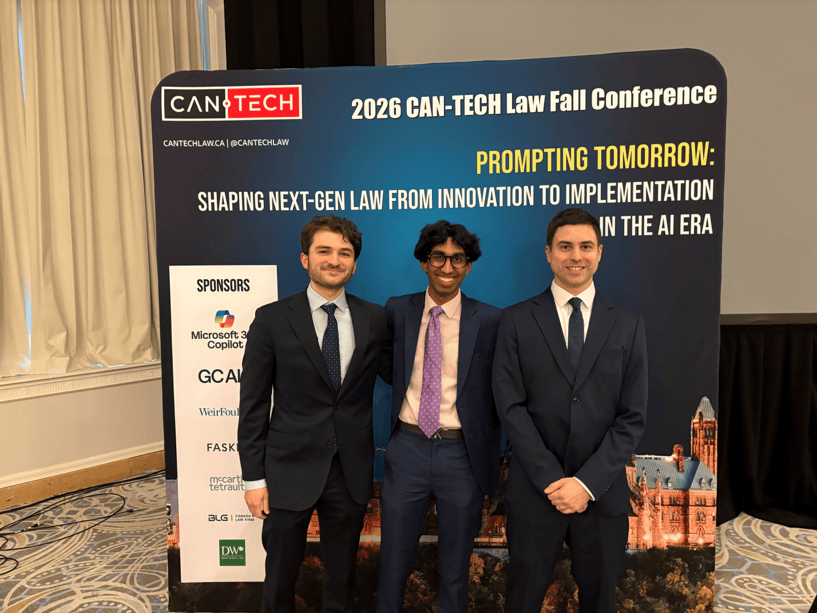
This year’s conference focussed on AI regulation, in large part inspired by recent moves that the Canadian government has been making in the space such as its new AI strategy. But it also reflected the rise of up-and-coming legal AI startups like GC AI and Spellbook, who were also in attendance. The startup ecosystem was a common thread the lawyers in attendance mentioned, who remarked that the focus had been on blockchain just a few years ago.
I was privileged to attend the conference and found the lessons within AI policy and law particularly relevant to startups. For example, one panel focussed on open-source governance in the AI era. The panellists discussed software innovation and how AI models are rapidly reshaping concepts like open-source licensing, as AI systems are trained on potentially copyrighted material. There were even discussions on how this might impact legal AI tools.
CAN-TECH also featured direct conversations through various roundtables. AI played a pivotal role at one of these roundtable discussions, with conversations had around who might own “AI Slop”. It was fascinating learning about how international jurisdictions have made decisions on whether AI can qualify as an author of copyrightable works, or as an inventor for patents, and where Canadian law is heading on these dilemmas. These sorts of questions, unaddressed in Canada to date, are vital considerations for founders as they build their businesses.
We also discussed situations where a startup may have built its product using substantial AI output, and if founders could own them, or prevent a competitor from stealing them. These debates were incredibly helpful in formulating my thoughts for the Startup Clinic’s upcoming Town Hall at the Kanata North campus, where I will be presenting on the intersection of AI and intellectual property.
Another colleague of mine attended a roundtable on government procurement for emerging technology. Here, a part of the discussion was centred on the government’s moves to improve Canadians’ access to emerging technologies. One tangible move was the Small Business Procurement Program, which was supported by this year’s federal Budget. These financial allocations have allowed the government to expand pilot contracts for small businesses and scale successful emerging technology ventures via Innovation Solutions Canada. It was a reminder that today may be a historically beneficial time to launch a startup in Canada, while the government aims to prioritize the local retention of IP, and scaling tech suppliers in critical sectors like space and cyber defence.
To make these policies a priority, there was discussion that current IP ownership and licensing provisions for government procurement should be more aligned with market standards, to avoid greater risk for vendors. Should they do that, there may be a greater level of trust for startups to sell their technology to the government, or to raise money through angel investors who are more certain on their valuations.
But above all, what I most appreciated about CAN-TECH was the mentorship. Hearing from leaders in the space raised one common theme: you become a trusted leader for technology companies by being good at the fundamentals like basic contracts, corporate governance, employment law, and IP. These are the very same tools that we at the Startup Law Clinic discuss with founders as a part of our repertoire of legal information.
The same reality applies to founders too: thinking about questions around corporate governance or protecting IP, especially in the age of AI, is a proactive way of protecting your business while you wait to receive tailored legal advice.

